
 07584 319522
How to Clean Gutters Without Ladders Safely
Last Updated: November 19, 2026
Quick Summary
To clean gutters without ladders, use ground-level tools such as a telescopic pole, gutter vacuum, gutter claw or leaf blower attachment so you never work at height. Start at the downpipe end, work backwards along the channel, match the tool to the debris, then flush with water to check flow. A typical roofline can be cleared in under an hour on a dry, still day.
- Clear the downpipe outlet first, then work backwards along the channel towards yourself.
- Dry leaves suit a blower or scoop, but wet sludge needs a gutter claw then suction.
- Never flush moss into the downpipe, as it sets like concrete and blocks drainage.
- Clear gutters in late autumn and again in spring, or every three months near mature trees.
- Call a professional for gutters three storeys up or fragile, damaged or asbestos rooflines.
Table of Contents
- Why Ground-Level Gutter Cleaning Beats Ladder Work
- Gutter Cleaning Tools That Keep You on the Ground
- How to Remove Leaves From Gutters Step by Step
- Working Around Gutter Guards and Awkward Rooflines
- How Often to Clean Gutters in a British Climate
- Checking Water Flow and Disposing of Debris Responsibly
- When Professional Gutter Cleaning Is the Smarter Choice
- Booking a Ladder-Free Gutter Clean for Your Property
- Frequently Asked Questions
Why Ground-Level Gutter Cleaning Beats Ladder Work
Learning how to clean gutters without ladders is the single best safety decision a homeowner can make. Falls from height remain one of the most common causes of serious injury in the home, and a wet gutter on a windy day is about as unforgiving as it gets.
Ground-level cleaning removes the risk entirely. You stand on a path, not a rung.
The benefits stack up quickly:
-
No working-at-height risk, so no fall prevention worry
-
You stay off fragile fascia and soffit boards
-
Fewer ladder marks on render and guttering
-
Easier to spot a gutter blockage from a safe angle
The trade-off is reach and use. A ground-level method suits single and two-storey homes well. Beyond that, access gets harder.
Gutter Cleaning Tools That Keep You on the Ground
The right gutter cleaning tools do the reaching so you don’t have to. Here is a general overview of equipment commonly used for ground-level clearing.
- Telescopic pole: extends your reach to first-floor guttering, with interchangeable heads
- Gutter vacuum: a wet and dry vac with a long wand and suction hose
- Gutter scoop or gutter claw: grabs leaves and clumps by hand
Telescopic Poles and Gutter Vacuums Compared
Both methods work. They suit different jobs, and picking the wrong one wastes an afternoon.
| Tool | Best For | Main Drawback | Suits |
|---|---|---|---|
| Telescopic pole with scoop | Light leaf litter, single storey | Awkward on wet, compacted debris | Quick DIY clears |
| Gutter vacuum | Heavy debris, two storeys | Needs power and a long hose run | Regular maintenance |
| Leaf blower attachment | Dry leaves in long runs | Useless once debris is wet | Autumn tidy-ups |
| Pressure washer | Stubborn staining | Can force water behind fascia | Occasional deep cleans |
A telescopic pole is simple to use. A gutter vacuum offers more suction power for heavier debris.
How to Remove Leaves From Gutters Step by Step
Cleaning gutters from the ground follows a simple sequence, but the tools change depending on what is sitting in the channel. Work methodically and you will clear a typical roofline in under an hour.
- Check the weather. Dry debris is far lighter and easier to shift. A dry, still day is ideal; avoid working in wind, which blows debris back into the channel or into your face.
- Set up safely. Stable footing, gloves on, goggles on. Keep the base of the pole clear of trip hazards and make sure the ground is not slippery.
- Start at the downpipe end. Clear the outlet first so water and loosened debris have somewhere to escape.
- Work backwards along the channel. Pull debris towards you, not away, so you are not pushing it into a section you have already cleared.
- Match the tool to the debris. Dry leaves suit a leaf blower attachment or a scoop. Wet, compacted sludge needs a gutter claw to break the bond first, then suction or a flush. Do not try to scoop wet leaves with a blower, it will simply smear them along the channel.
- Clear the downpipe. A clogged downpipe backs up the whole system. Feed a drain rod or hose down from the outlet and work it through the bend.
- Flush with water. Check water flow runs freely to the drain. A bucket poured in at the high end is the simplest test.
- Bag the debris. Never wash it into the drainage system.
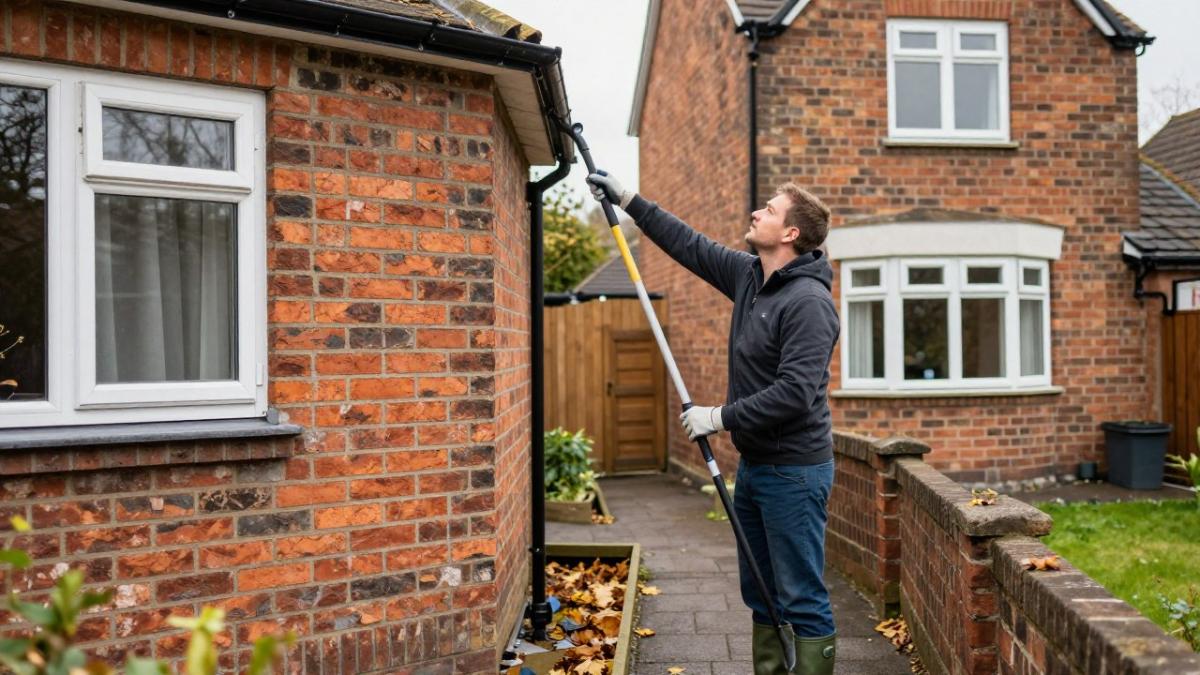
Dealing With Wet Leaves, Moss and Compacted Debris
Wet leaves are the hard part. They cling, they weigh a lot, and a scoop alone will not shift them.
Moss is a different problem. If moss is spreading across the tiles, our guide on how to remove moss from roof tiles without causing damage covers the safe approach.
Watch out: never flush a heavy moss load straight into the downpipe. It will set like concrete and turn a small job into a blocked drainage system.
Dry Leaves vs Wet Sludge: Which Tool Wins
Most guides treat gutter debris as one problem. In practice, the two common states need different approaches:
- Dry leaves and twigs: a leaf blower attachment or a scoop is fastest. The debris is light and will travel along the channel with a gentle push. A blower is useless once debris is wet.
- Wet, compacted sludge: a blower will smear it; a scoop will skate over it. Use a gutter claw to break the bond, then a wet and dry vacuum to lift it out. A flush alone will push sludge into the downpipe and block it.
- Moss and grit: scrape rather than push. A gutter brush followed by suction clears the residue that a scoop leaves behind.
A common pattern is to start with the blower on a dry autumn day, then switch to the claw and vacuum for the compacted sections near the downpipe, where debris collects first.
Working Around Gutter Guards and Awkward Rooflines
Gutter guards change the job completely, and most guides ignore them. Mesh, brush and foam guards keep large leaves out but let grit, small debris and moss through, so the channel still silts up over time. You cannot scoop through a mesh, so the method has to change.
Cleaning Gutters With Guards Fitted
The right approach depends on the guard type:
- Mesh and perforated guards: suction is usually the only ground-level option. A wet and dry vacuum with a narrow wand can draw debris through the mesh if it has not compacted. Work along the channel in short passes rather than one long drag.
- Brush guards: these trap debris in the bristles. A leaf blower attachment can lift loose material off the top, but compacted debris underneath needs a flush from above or a section lifted.
- Foam guards: foam degrades over time and sheds crumbs into the channel. Suction clears the crumbs; if the foam has broken down, the guard itself needs replacing rather than cleaning.
A common pattern is for debris to compact at the low end of the run, near the downpipe, where water sits longest. Start there and work uphill.
Watch out: forcing a pole through mesh risks bending the guard and damaging the fixing. If the guard is screwed or clipped down, lifting a section is a two-person job and often the point at which a professional is the cheaper option.
Awkward Rooflines
Awkward rooflines add their own challenges:
- Valleys and hips: debris collects where two roof planes meet. A telescopic wand may not reach the centre of a valley, so a flush from the high end is often the only ground-level method.
- Conservatories: low roofs are easy to reach but awkward to clear because the gutter sits tight against the house wall. A short pole with an angled head works better than a long straight wand.
- Dormers: tight gaps trap leaves against the fascia. A gutter claw on a short pole reaches where a vacuum head will not fit.
Where a guard is fitted and debris has compacted underneath, the sensible move is to lift a section or call in a professional. Forcing a pole through mesh risks bending the guard and damaging the fixing.
How Often to Clean Gutters in a British Climate
Many homes benefit from clearing gutters in late autumn after leaves fall, and again in spring. Homes near trees may need more frequent attention.
The British climate makes this matter. Wet winters and windy autumns push debris into the channel fast, and overflowing gutters soon soak the fascia and walls.
Adjust your schedule for:
- Mature trees nearby: clear every three months
- Exposed, windy spots: check after every storm
- Flat or low-pitch roofs: debris sits rather than slides
Preventative maintenance beats emergency repairs every time. A quick check after heavy weather saves a costly roofline repair later.
Checking Water Flow and Disposing of Debris Responsibly
A clear gutter is only half the job. Water flow tells you whether the whole system works.
If water sits, you still have a gutter blockage. If it backs up at the downpipe, the clogged downpipe needs clearing before anything else.
Disposal matters too. Bag leaves and moss for garden waste collection or compost them. Never hose debris into the drainage system, because it silts up drains and can cause local flooding.
When Professional Gutter Cleaning Is the Smarter Choice
Some jobs are simply not worth the risk. Professional gutter cleaning makes sense when the height, the access or the condition of the roofline puts you in danger.
Call in a professional if:
- Your gutters are three storeys up or higher
- The roofline is fragile, damaged or asbestos
- Guards are fitted and debris has compacted underneath
If you would rather stop DIY-ing altogether, you can see the gutter fascia cleaning service we offer and what it covers. Our team is qualified in a range of cleaning methods.
Booking a Ladder-Free Gutter Clean for Your Property
Arranging a clean is straightforward. You can check our local gutter cleaning service for coverage and details, or look at a completed gutter cleaning project in Milton Keynes to see the results.
For busy households and commercial property managers, a scheduled clean takes the job off your list entirely. When you are ready to arrange it, our contact page is the quickest way to get in touch or request a quote.
Clearing a roofline from the ground is safer, faster and easier on your home than balancing on a ladder. If height, access or fragile materials make the job risky, that is exactly where we step in.
Frequently Asked Questions
Can a gutter vacuum clear wet leaves and compacted debris?
Yes, a wet and dry vac with a gutter vacuum kit handles wet leaves, moss and sludge that a pole and scoop struggle with. The suction lifts compacted material out of the channel, and a u-bend or hook attachment reaches into the gutter run. Check the drum capacity before you start, because a long run of blocked guttering fills a small vac quickly. Empty it before it overfills, and never use a domestic indoor-only vacuum for this job.
How can I tell whether my gutters are clear without climbing up?
Watch the water flow during heavy rain. If water pours over the fascia instead of running down the downpipe, or you see staining below the roofline, there is a blockage. You can also pour a bucket of water into the gutter from an upstairs window and listen for it reaching the drain. A telescopic pole with a mirror attachment lets you inspect the channel from ground level. Any sagging, cracked joints or loose brackets need a closer look.
How often should gutters be cleaned?
Twice a year suits most homes: once in late autumn after leaf fall and once in spring. Properties surrounded by trees, or with long gutter runs, may need three or four visits a year. Flat or low-pitch roofs and gutters with guards still collect grit and moss, so check them at the same intervals. Clearing before winter matters most, because frozen blockages can crack joints and pull brackets away from the fascia.
Can I use a pressure washer to clean gutters from the ground?
A pressure washer with a telescopic lance can shift surface grime, but it is a poor choice for clearing a blockage. The force pushes debris further along the run and can spray water behind the fascia or under roof tiles. It can also damage sealant and loosen joints on older guttering. Use low pressure for rinsing only, and rely on a gutter vacuum or scoop for debris removal. For anything three storeys up, call a professional gutter cleaning service.


